






Lunar Crater Catalogue LCC

| Published: | 16.01.2026 |
Source of data
Modifications for LCC
Columns + content
Column descriptions
- name_*
- type
- side_*
Small flaws
Conceivable extensions
Download
- SQL
- Povray
Example images
Modifications for LCC
Columns + content
Column descriptions
- name_*
- type
- side_*
Small flaws
Conceivable extensions
Download
- SQL
- Povray
Example images
Source of data
The only source of data so far are two text files that Jonathan C. McDowell has deposited on his private website and that I am allowed to publish prepared with his consent.
https://www.planet4589.org/astro/lunar/
According to his statement, the data originally came from the USGS. I couldn't find a database or table on their pages, but for the sake of completeness it should also be mentioned.https://planetarynames.wr.usgs.gov/ As far as the total number of inputs is concerned, all surface features larger than 10 kilometers are likely to be included, perhaps even down to one kilometer. One decimal place for positions (latitude and longitude) at 10,920 kilometres of lunar circumference results in an accuracy of 3 kilometres. This is not important for large surface features, but in the case of small satellite craters, there is a visible deviation from the crater center.
Modifications for LCC
The text files Craters and Features of the source website were combined, converted (special characters), converted into an SQL table and then extended by columns.
I have corrected errors in the name column name_real and created more from the result:name_ascii, name_uri, name_short, name_tiny Crater dependencies were derived from the existing data:
num_sats, is_sat, parent_id, parent_ascii
Columns + content
| id | ID, ascending |
| name_real | Name with special chars |
| name_ascii | Name without special chars |
| name_uri | Lower letters, ascii, without spaces |
| name_short | Abbreviation of 3 letters + satellite crater postfix |
| name_tiny | Satellite crater postfix only |
| type | Type of the entry (Crater, Mare, ...) |
| size | Size or dimension |
| lat_d | Latitude in degree (-90 to + 90) |
| lon_d | Longitude in degree (-180 to +180) |
| lat_o | Latitude in degree + direction (0 to 90, N = north, S = south) |
| lon_o | Longitude in degree + direction (0 to 180, E = east, W = west) |
| num_sats | In case of main crater number of satellite craters |
| is_sat | Main crater = 0 and satellite crater = 1 |
| parent_id | ID main crater |
| parent_ascii | Name main crater |
| side_* | On which side of the moon visible, see below |
| first_desc | First description, see list |
| first_nom | First nomenclature citation, see list |
Column id is an ascending number, not a unique crater ID, it may change in a new version.
Column descriptions
name_*
name_real is the only column that contains special characters (e.g. Abul Wáfa). All others consist only of ASCII characters, special characters have been converted (á, à, â, ã, ā => a), German umlauts separately (ä => ae). I created the catalog primarily for use with the Povray scripting language, which suffers from a certain special character intolerance. This column is not included in the Povray array for now.
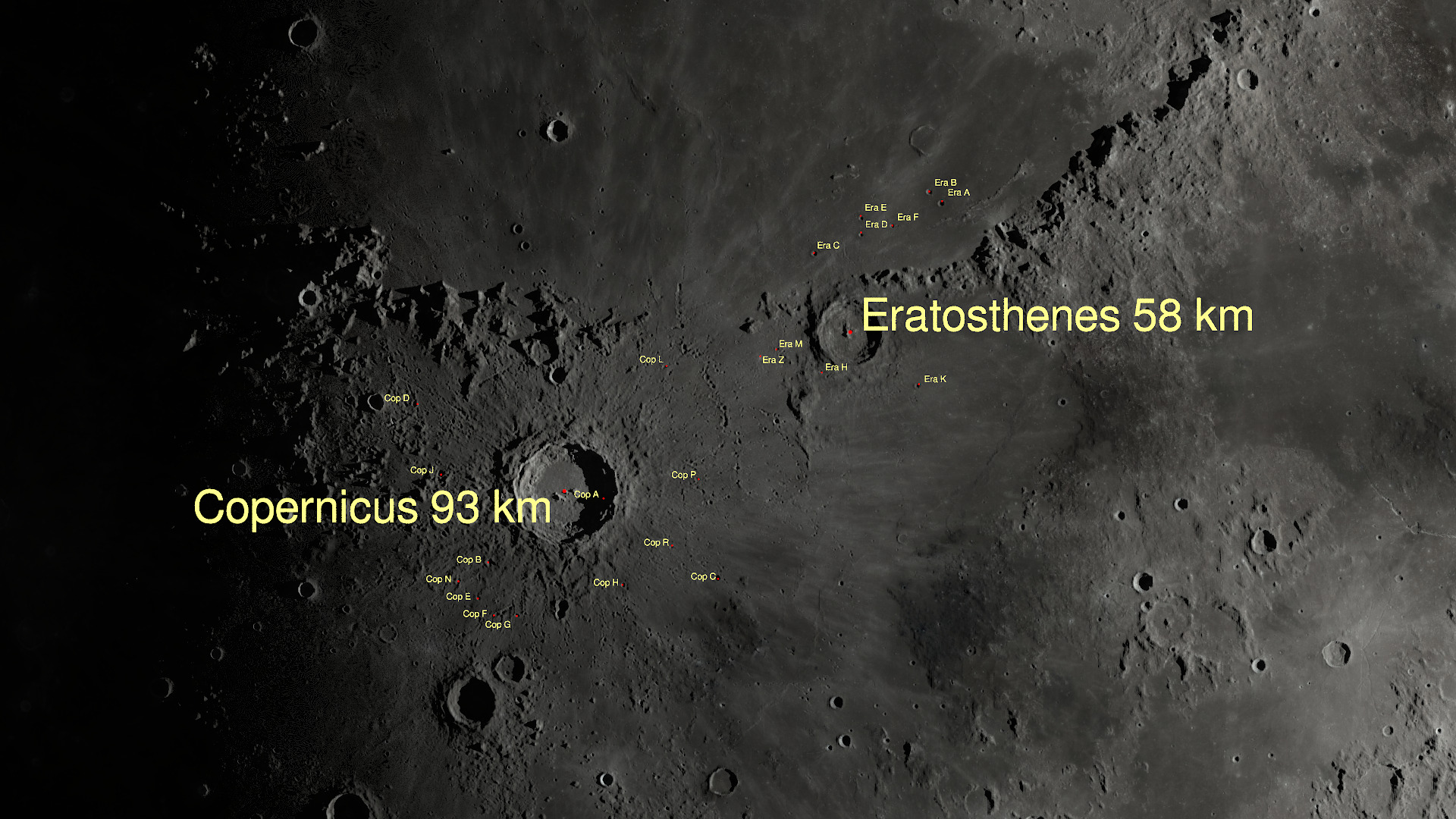
name_short and name_tiny are helpful with regard to satellite craters. Short contains the first 3 characters of the name + the satellite crater postfix, e.g. Cop A for the first satellite crater of Copernicus. Tiny contains only the postfix, so it is empty for main craters.
type
Apart from craters, other surface features are also included in the catalog.The number of entries per type can be determined with the following SQL statement.
SELECT type, count(*) FROM lcc_10 GROUP BY type ORDER BY count(*) DESC
63 entries are designated as Crater (A). These are mini-craters, some without official names, which were named during Apollo missions for orientation.
side_*
The side_* columns indicate on which side of the Moon the crater is located. Specifications for front, back, west, east, north, south respectively, so that specific craters of one side can be selected without error-prone calculations with Latitude and Longitude.Column site_fbwens summarizes all six information in one string. Value "101010" represents a crater that can be seen on the front side (earth faced), west side, and from the north.
Small flaws
A handful of craters are recorded with a diameter of 0. These are either incorrect entries, or the number is below the accuracy for the information.
Conceivable extensions
There is another data source for lunar craters, which contains fewer columns, e.g. no type information such as craters and mares, and does not list some types at all, but offers one more decimal place for position information and size. A more accurate version could be created from the combination of both sources.
An integrated list of all landing sites would be nice, from Apollo to the latest mini-landers, some of which even landed upright.
I skipped both tasks for the first version. Especially the addendum of all landing sites would be an estimated 10 to 20 hours of search and manual work. Lists found so far have been incomplete or in a format that cannot be easily imported. Examples of the latter are various HTML tables on Wikipedia.
Download
Current version is LCC 1.0 or lcc_10 from January 2026.
SQL
The SQL import file is optimized for MySQL or Maria-DB. It contains a drop-table statement, the table name is lcc_10, a database is not created. Imported, the table is 2 MB in size.Indexes are created for the following columns: id, name_ascii, parent_ascii, parent_id. The file was exported using the PHP database tool Adminer 5.4.1 and successfully imported. SQL-Download
⬇ dbmoon_lcc_10_sql_complete.sql => 1,5 MB
Povray
The text file can be included in Povray and contains a string array with all the necessary information. Integer or float variables must be converted before use, as Povray does not allow arrays with different data types (string, integer, float) in version 3.7. Povray does also not like special characters, so the column name_real is not included in the array, name_ascii serves as a replacement.Columns that are not needed for display have been omitted: name_uri, lon_o, lat_o, first_desc, first_nom.
Of the columns side_*, only side_fbwens is included. What the array file looks like can be seen in a mini-example. Povray-Download
⬇ dbmoon_lcc_10_pov_all.inc => 1,3 MB
Example images
Rendered with Povray, more are in the works.
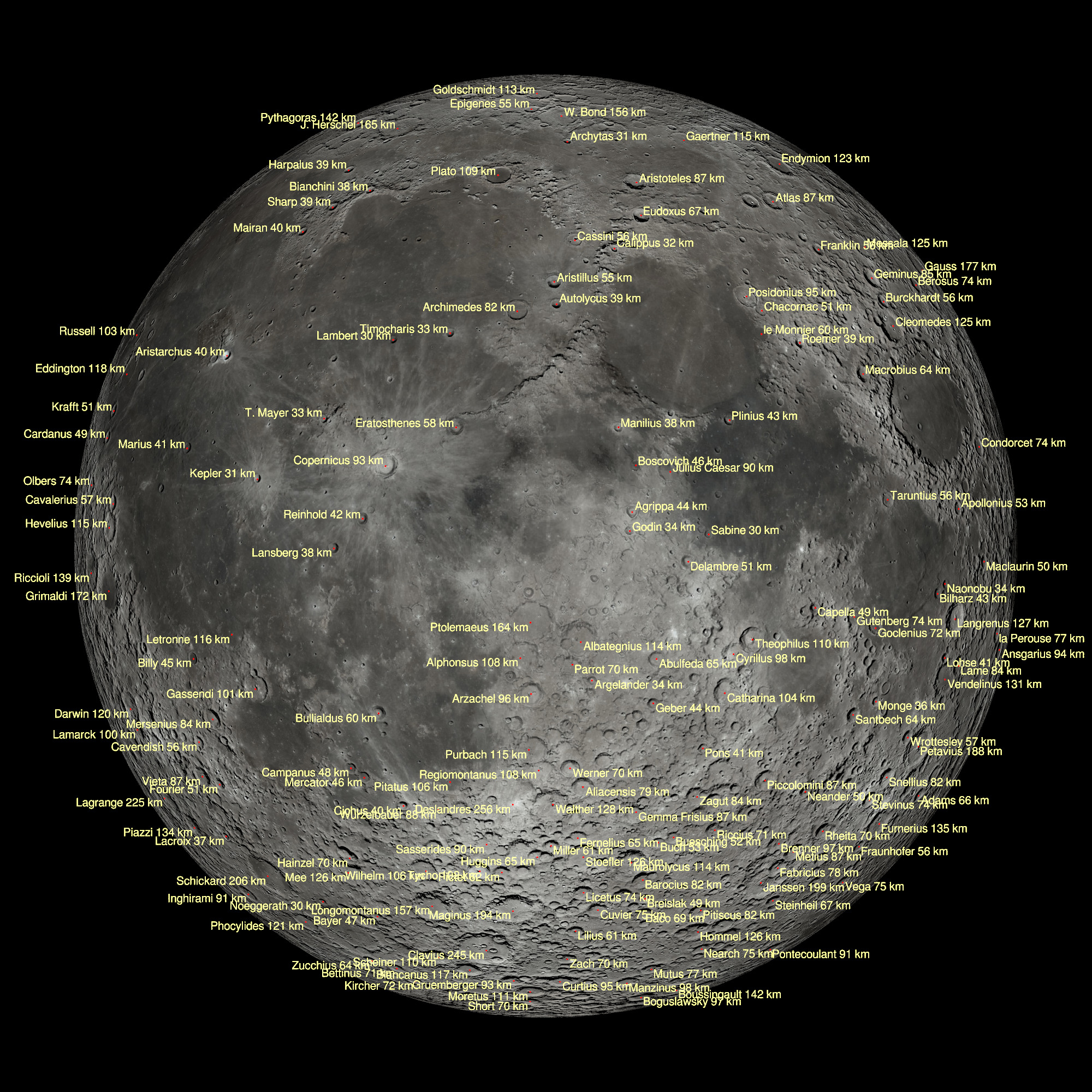
Foreside of the Moon
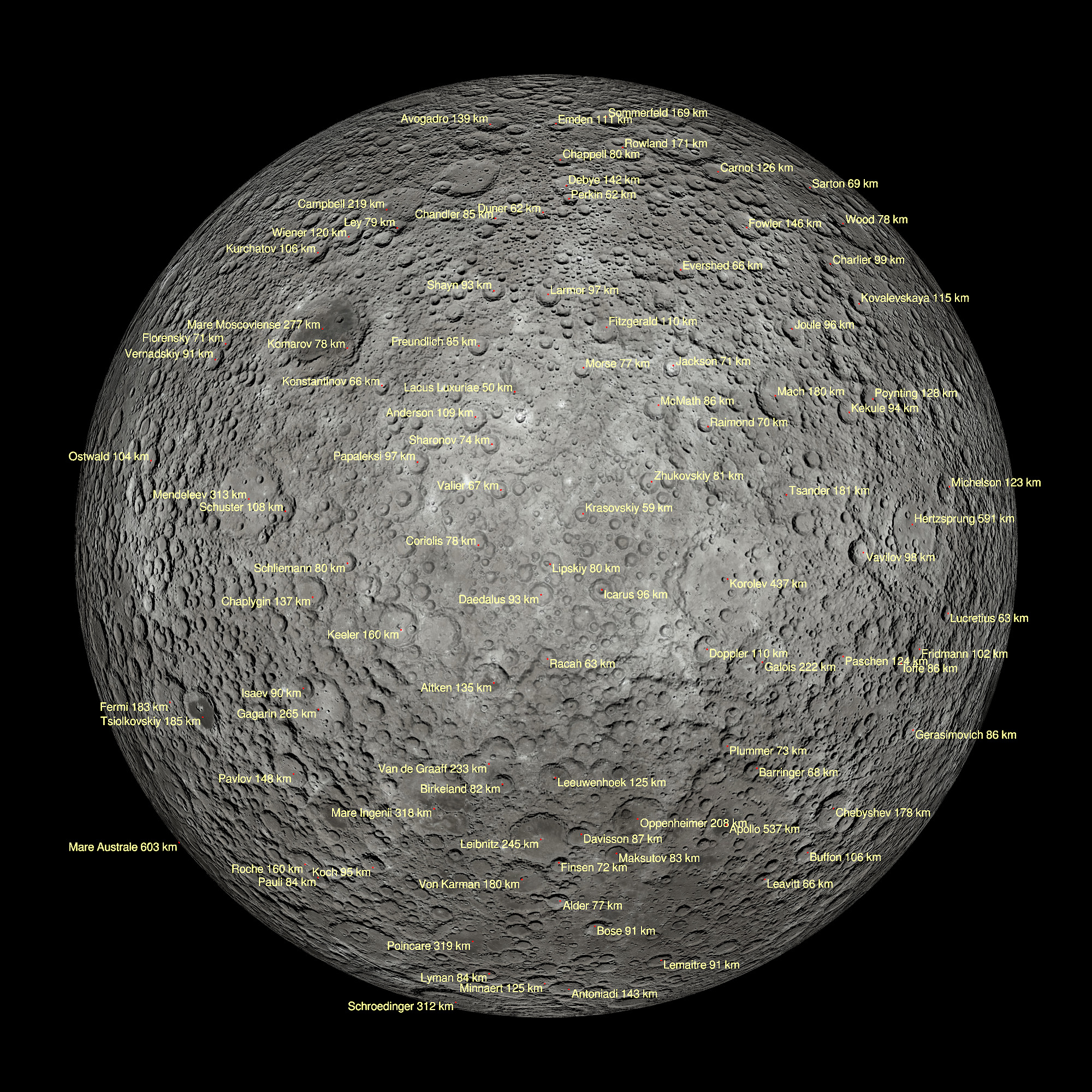
Backside