






RISSO Catalogue
| Published: | 31.03.2026 |
Source of data
Definition Risso
Seriousness
My bet
Columns + content
Known flaws
Companions or planets
Conceivable extensions
Download
- SQL
- Povray
Animation
Definition Risso
Seriousness
My bet
Columns + content
Known flaws
Companions or planets
Conceivable extensions
Download
- SQL
- Povray
Animation
Source of data
© Wikipedia
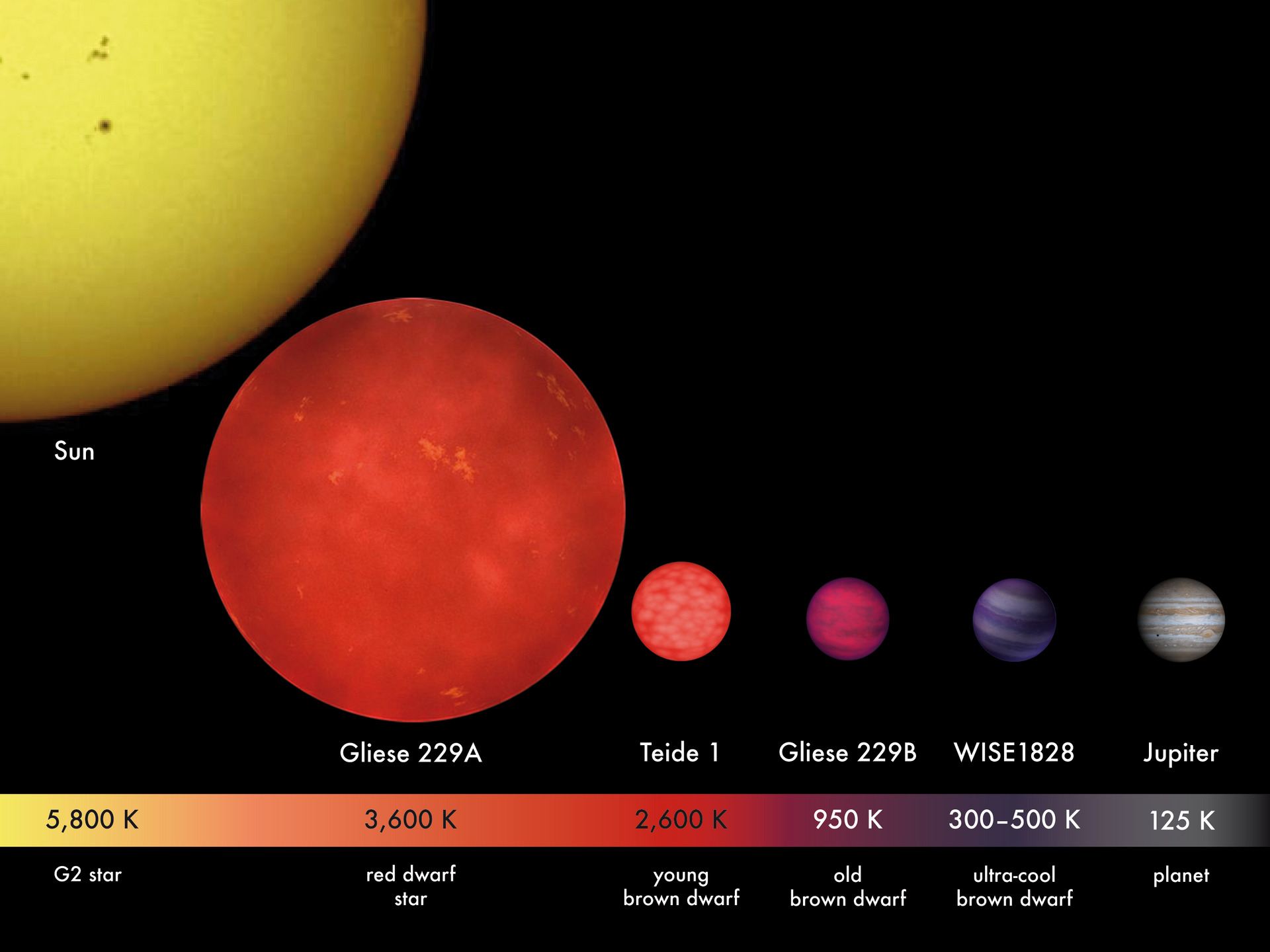
Definition Risso
A Risso ...• is a natural, round, at least planet-sized object
• is not a star, has less than 80 Jupiter masses (maximum value)
• does not orbit a star
• can form Risso multi systems
• can be orbited by planets A Rissos can be of type or designation:
• brown dwarf
• sub-brown dwarf
• planetary-mass object
• free-floating planet They form a star system, in the center of which there is no star, but at most a full-grown brown dwarf. Or just a planet with even smaller companions. This means that a brown dwarf in the orbit of a Sun-like star is NOT a Risso, and exoplanets are even less so. Well-known Rissos: Luhman 16, WISE 0855−0714, WISE J1711+3500, UGPS J0722-0540. Also included in the catalogue, at least for the time being, are planets orbiting them, marked with lowercase letters at the end of their name. Equivalent companions that together form a multi-system are marked with capital letters, see explanations of the columns ident1, ident2 and type.
Seriousness
© Wikipedia
My bet
As of March 2026 we have ...- 766 known Rissos
- 754 Risso systems
- 14 systems within a radius of 20 light years My prediction for New Year's Eve 2035 (in 10 years)
- more than 10,000 known Risso systems
- more than 200 systems within a radius of 20 light-years
- at least one Risso at a maximum distance of 2.999 light years from Earth That's my bet, anyone can pin me down to it.
Noted on 31 March 2026.
Signed: Martin Seydler
Columns + content
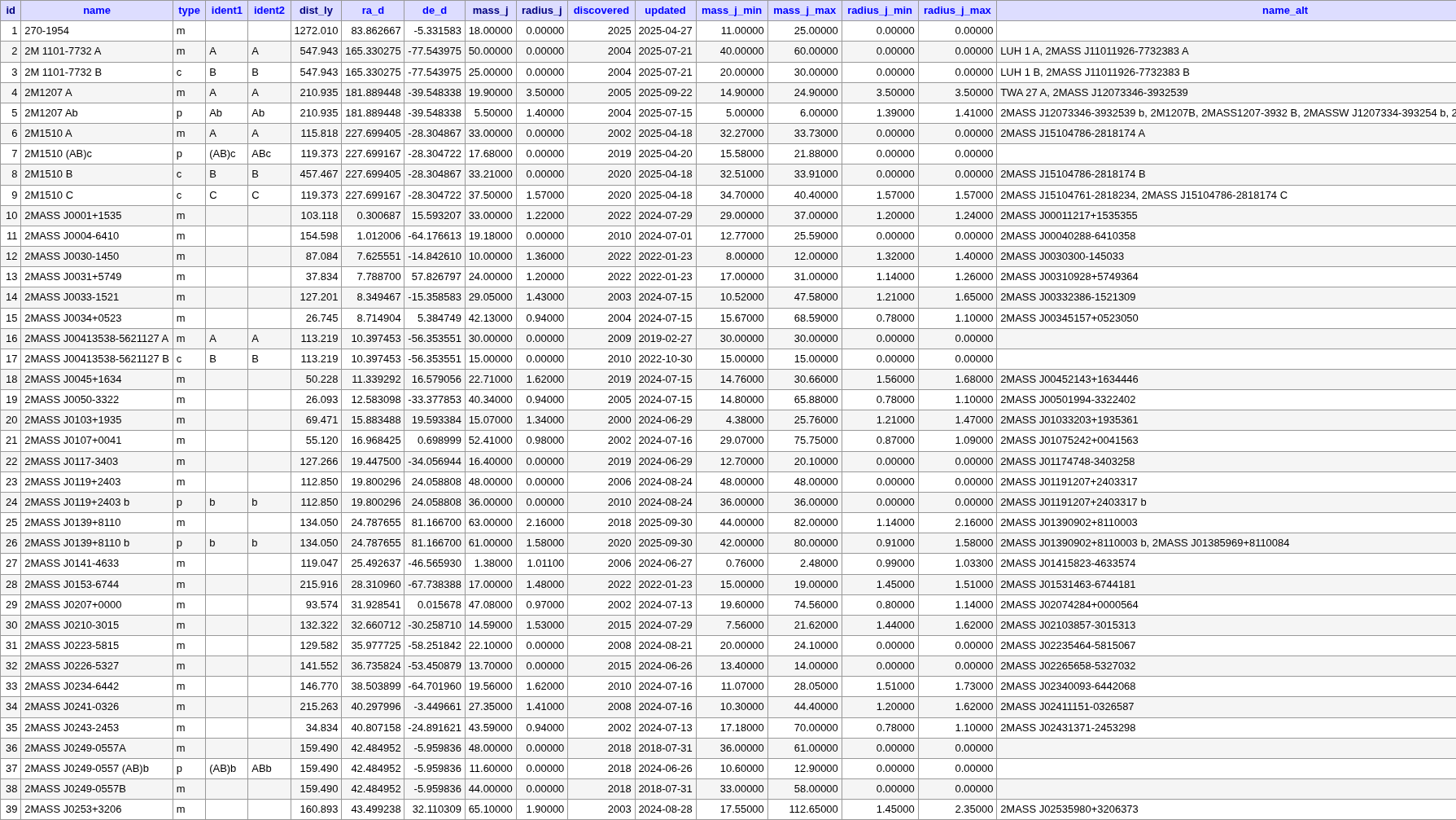
| id | ID, ascending |
| name | Name/designation |
| type | Object-Type (m = main, c = companion, p = planet) |
| ident1 | Fraction extracted from the name, which indicates the valence in multi Risso systems. A stands for the primary (Main), B for the Beta-Risso (Companion), lowercase letters indicate planets. No specification (empty string) means main Risso without known companions. |
| ident2 | Same as ident1, but without parentheses () |
| dist_ly | Distance in light years |
| ra_d | Right ascension in degree (0 to 360) |
| de_d | Declination in degree (-90 to +90) |
| mass_j | Mass (in Jupiter masses, mean value) |
| radius_j | Radius (in Jupiter radii, mean value) |
| discovered | Year of discovery |
| updated | Date of last record update by Exoplanet.eu |
| mass_j_min mass_j_max | Minimum and maximum mass (error range from/to) |
| radius_j_min radius_j_max | Minimum and maximum radius (error range from/to) |
| name_alt | Alternative names |
Column id is not a Risso-id, but rather a sequential number, which may well change in the next version.
Known flaws
A handful of entries contain 0 values for mass_j, several hundred for radius_j. Hopefully, this will be corrected by a future update.
I haven't done any case-by-case checks of the objects, so there are erroneous entries that don't belong in this catalogue. I noticed GJ 1001 C at a distance of 40 light years, which does not have a main Risso assigned to it, and the actually existing star GJ 1001 (without C) is located at a distance of 12 light years.
Unfortunately, the Exoplanet.eu database does not contain any information for brightness (magnitude) and spectral type. This is a pity, some of the data can be viewed on Wikipedia, but both can be estimated with the help of the columns mass_j and dist_ly.
Companions or planets
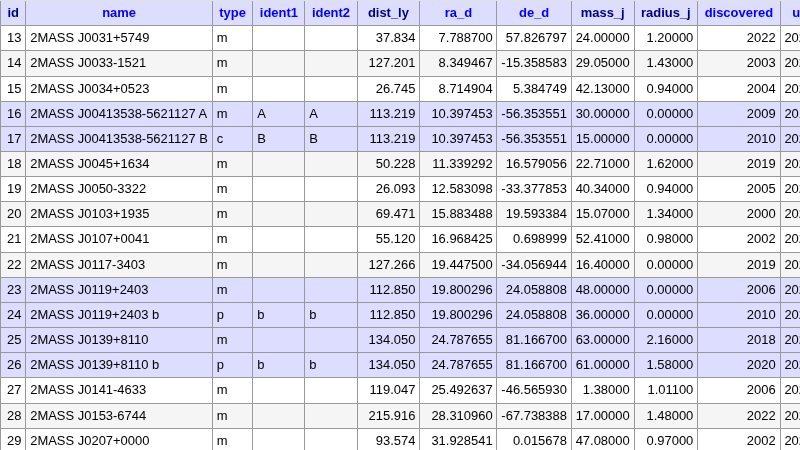
The information in column ident1+2 cannot always be relied upon, which is due to measurement inaccuracy and its interpretation. This type of information may change in future versions.
If b is the planet of a brown dwarf, it can also be a double risso of two similarly sized brown dwarfs. In such cases, the b may eventually become a B or even C.
For this reason, I have left the 103 possible planets in the catalogue for the time being, although they make little sense without further data (orbital parameters). To filter out the planets, only the column type has to be tested for not equal to 'p'.
Conceivable extensions
This is the first version of which I still have to find out if I will be happy with it. It contains the most important data such as name, position and distance, so you know where to find them. Whether this is enough, I will find out after the first uses.
It would be possible to manually add missing data (brightness, spectral type,...), at least for Rissos in the immediate vicinity.
In addition, orbital parameters for the planets could be inserted, but I have not yet tested whether they are correctly entered in the database of Exoplanet.eu.
And maybe the division into name and ident1+2 could be improved.
It could therefore be that column names and content turn out differently in an update.
Download
The current version is RISSO 2603 or risso_2603 of March 2026 with 869 entries, based on a database query at Exoplanet.eu of March 13, 2026.
SQL
The SQL file creates a database table called risso_2603, preceded by a drop-table statement. A database and indexes are not created. The import file was created with the PHP database tool Adminer 5.4.1.
SQL-Download⬇ dbstars_risso_2603.sql => 149 KB
Povray
The text file can be included in Povray and contains a string array with all the necessary information. Integer or float variables must be converted before use, as Povray does not allow arrays with different data types (string, integer, float) in version 3.7. I omitted data that is not absolutely necessary for the display when creating the file.
What such an array looks like can be seen in a mini-example.
Povray-Download⬇ dbstars_risso_2603.inc => 88 KB
Animation
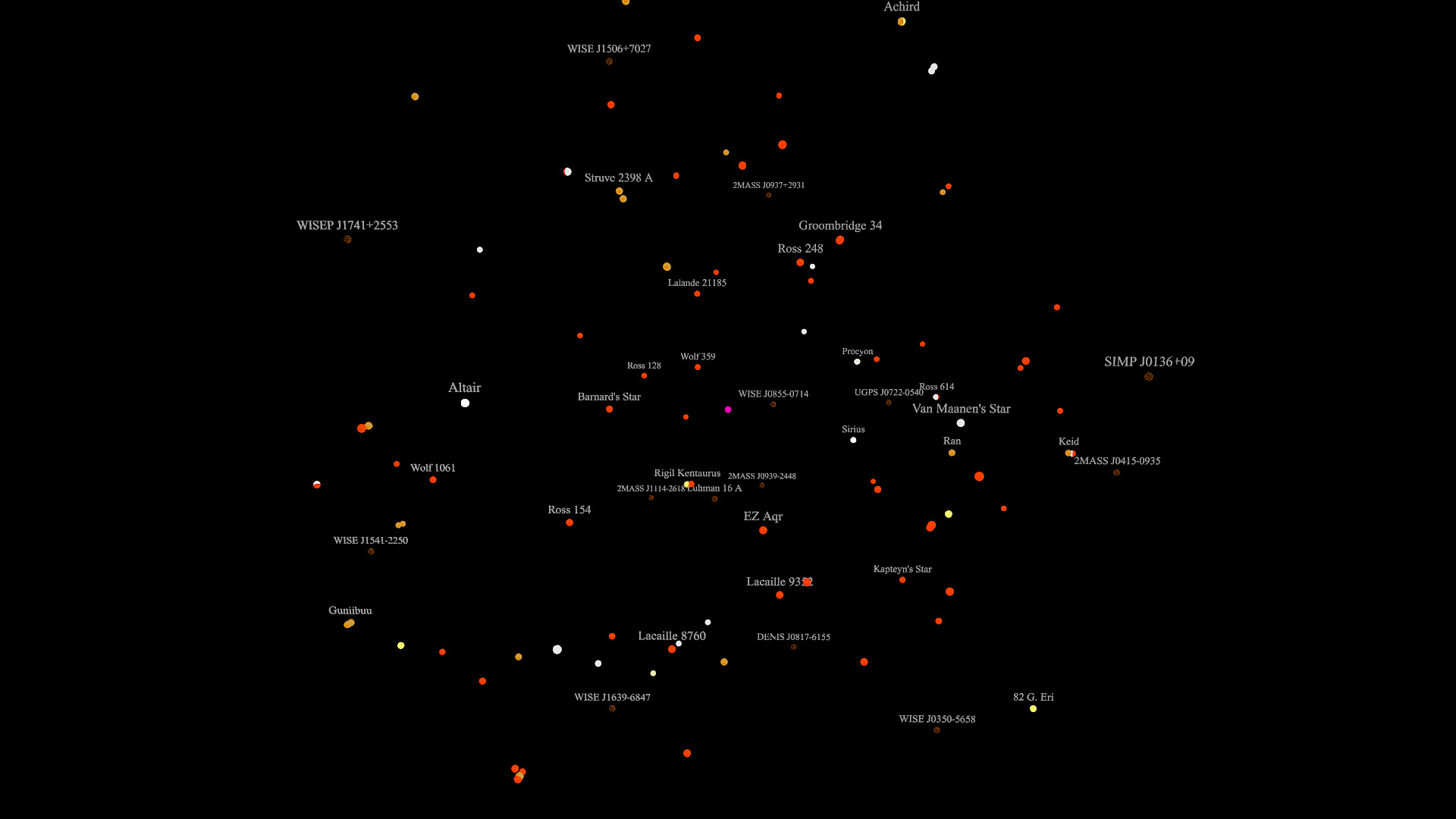
For more videos, see my blog post from January 2026.
50 seconds - 1920x1080 px - 15.3 MB
1500 frames - 30 fps - 20 crf - lib264
1500 frames - 30 fps - 20 crf - lib264