



Our stellar red Neighborhood

30.01.2026 - 12:30 pm
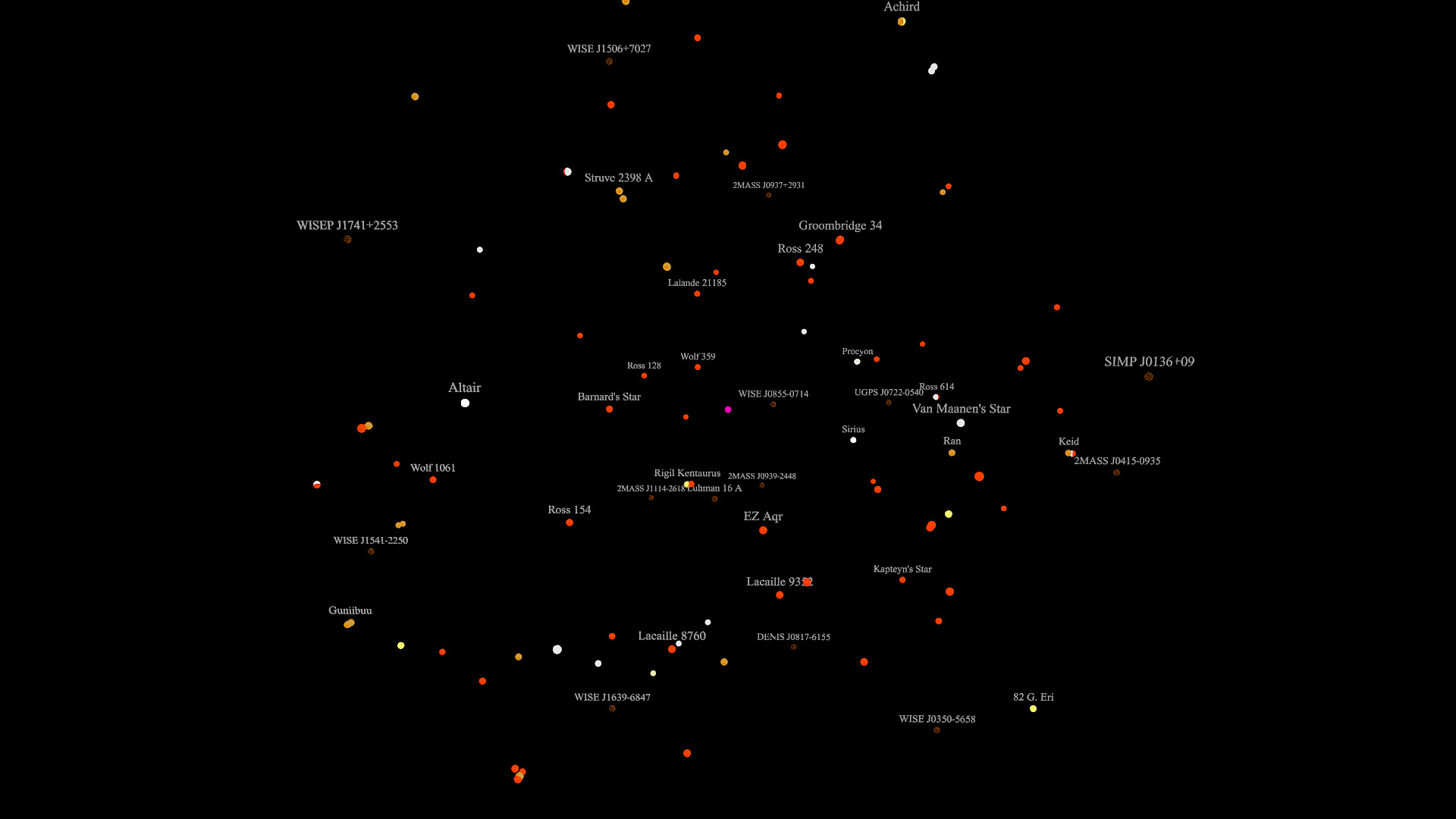
Back in 2018 I made my first attempts to convert a star database into animations with the help of Povray. I haven't touched this project for a long time, but now I wanted to improve the scripts further. For this I used a current star database, plus an unpublished one with non-stars, so-called brown dwarfs.

Above all, I wanted to colorize it so that the different types of stars could be distinguished, for main sequence stars colors from red to blue.

It quickly turned out that our immediate stellar neighborhood is a pretty red affair. The most common class of nearby stars are red dwarfs, which actually emit redder light and are smaller than our Sun.

In the first animation, all stars or spheres are the same size, showing all objects except planets that exist within 20 light-years of our Sun. The brown-black spheres are brown dwarfs - neither star nor planet - recognizable by cryptic names such as WISE J0855-0714. Our Sun is the pink sphere in the center of the image.

This are the first results that have been produced during development and that I consider presentable, thus not end products. If the videos stutter, it is probably due to the browser. The videos can be downloaded by right-clicking and "Save video as ..." or also displayed in a separate browser tab via context menu.

50 seconds - 1920x1080 px - 15.3 MB
1500 frames - 30 fps - 20 crf - lib264

Stereo-Anaglyph
50 seconds - 1920x1080 px - 21.7 MB
1500 frames - 30 fps - 20 crf - lib264

In the second attempt, objects within a radius of 100 light years can be seen. Theoretically, because the camera is also located at a distance of 100 light years, leaving less than 50 light years to the left and right. Star designations are only displayed up to a distance of 30 light years.

I also experimented with size differences. Red dwarfs are shown half the size of our Sun, everything from star class A slightly larger, white dwarfs are significantly smaller.

With more than 4,000 objects, this results in quite a mess, structures are hardly recognizable. Nevertheless, it's kind of interesting to see our extended neighborhood in motion.

On top of that, the videos were created with a lower quality level, instead of crf 20 as above, now crf 28 (FFmpeg setting). As a result, the file size shrinks to half, to my amazement without any visible changes in the video.

70 seconds - 1920x1080 px - 25.8 MB
2100 frames - 30 fps - 28 crf - lib264

Stereo-Anaglyph
70 seconds - 1920x1080 px - 42.3 MB
2100 frames - 30 fps - 28 crf - lib264

Looks nice, nicer than the old animations in my opinion, but there is still a lot to do.

The stars could look better and differences in size should be more visible. I could show the Milky Way in the background, as a reference point and so that it makes a less artificial impression.

In addition, the conversion of all coordinates from cellestial to galactic is necessary, for which I have to deal with sine and cosine for a few hours. This will be quite intense, because my knowledge of three-dimensional trigonometry is quite limited.

It's an interesting gimmick, I'll stay tuned and publish new results in due course.

See you