Events - 2029 to 2035 - The big Seven
I can still remember well how the Cassini spacecraft arrived at Saturn in 2003. After a loooong journey, it finally started, pictures in abundance, over years, and a landing on Titan as a little icing on the cake.
The same with
New Horizons, an exciting week to see if the flyby succeeds, and then new images over months. It was similar with Mars Pathfinder, Opportunity, Spirit, Curiosity, Perseverance and Ingenuity, Dawn.
But these
big projects, which really blow you away and delight you for years, are rather rare.
Therefore we can talk about luck that one monster event after another will take place from 2029 onwards. Three orbiters are already underway (as of March 2026), one lander is under construction, a double and a triple package is being prepared, and by the way - as icing on the cake weighing thousands of tons - the world's largest telescope is nearing completion.
These projects are to be presented here so that you can look forward to wonderful space times from spring 2029 onwards, away from political trouble. I don't like to get three years older - this time I can hardly wait.
All information is subject to change. The Trump factor in particular is quite unpredictable, so NASA projects may well be subject to changes, postponements or cancellations.
In some cases, it is possible to track where the individual spacecrafts are currently in our solar system.
For that see my extra page
Where Is.
2029 - Apophis
Ramses + Cubesats
Long heralded as a doomsday asteroid, the 450-meter-tall
Apophis will fly very close but harmless by Earth.
On Friday, April 13 at 21:46 UTC the time has come, at only 31,600 kilometers from the Earth's surface, below the orbits of geostationary satellites. It will be visible to the naked eye with
mag 3, a very rare event.
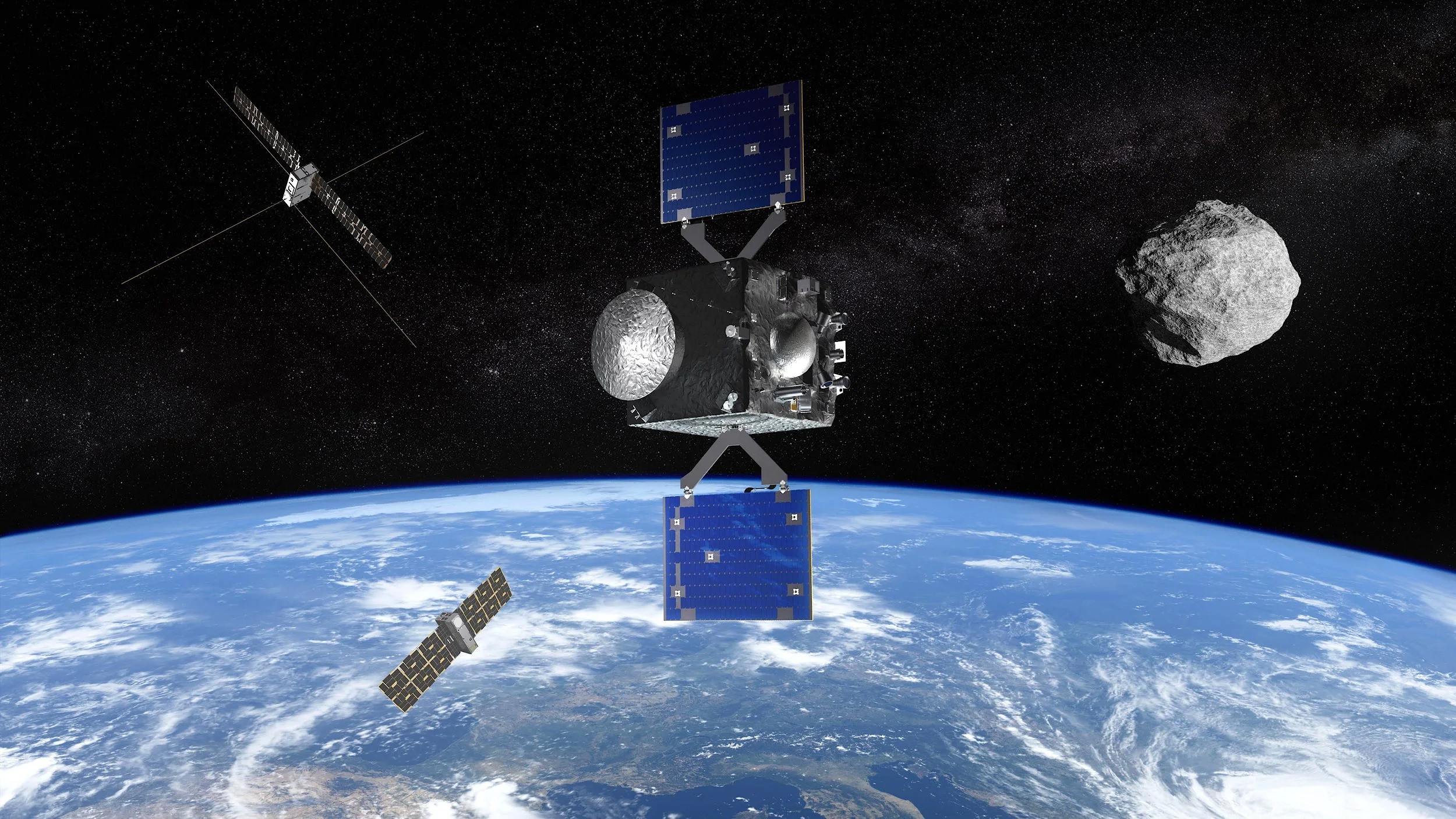
Apart from several dozens ground-based telescopes, two orbiters will observe the asteroid up close. The european
Ramses will launch in April 2028, reach Apophis before the flyby in February 2029 and take before-and-after images. NASA's
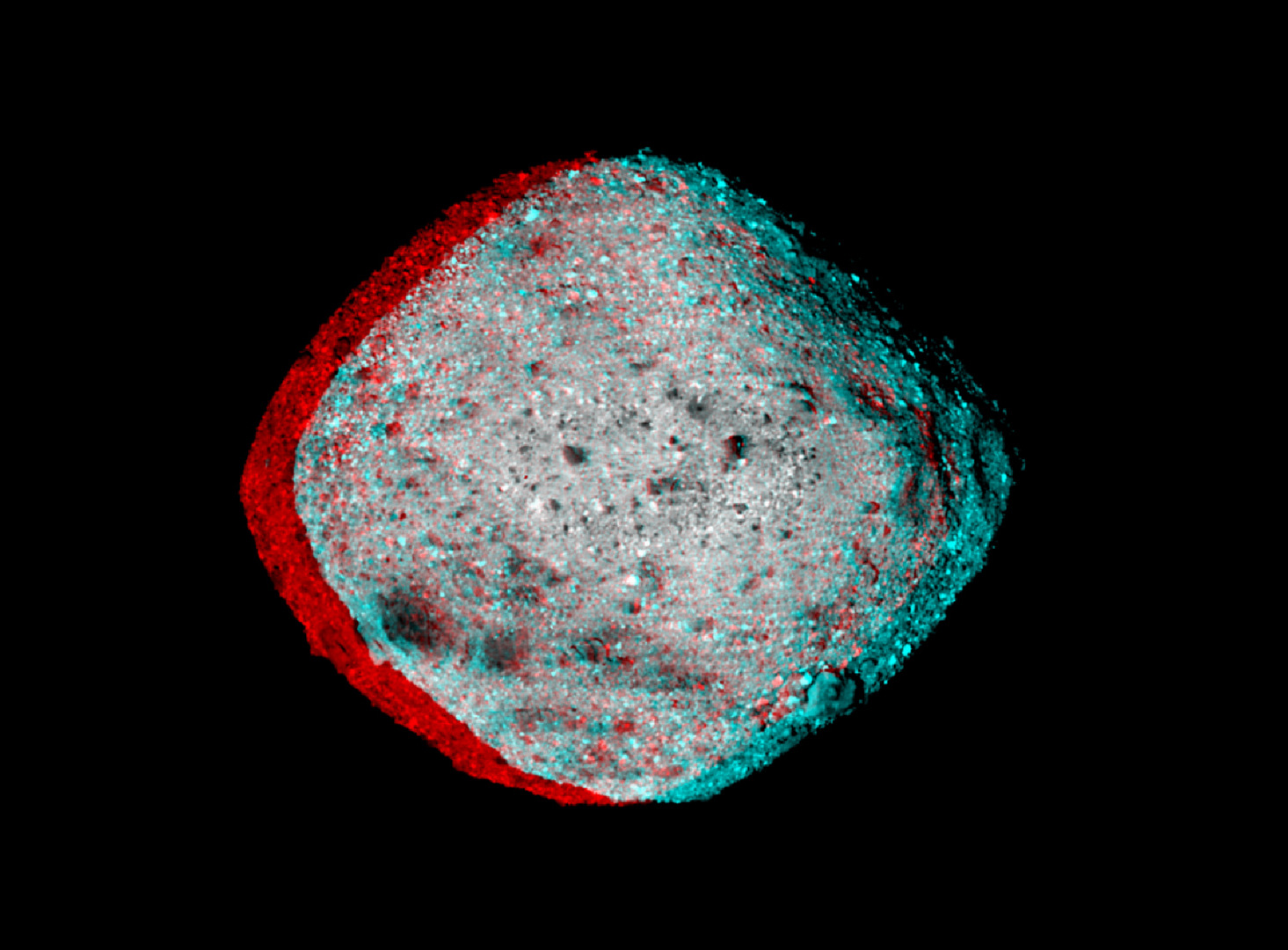
Osiris-APEX, which has already extensively studied the 550-metre-wide asteroid
Bennu down to the centimeter range, will enter orbit shortly after the flyby. Osiris-APEX could fall victim to Trump's red pen, he has already tried, but the spacecraft is actually already on its way.
If Apophis consists of a collection of debris and dust like
Bennu, that is only loosely held together by its very small gravitation, it could well change due to the Earth's gravitational field. It will not dissipate and will not explode, but it is possible that large chunks will shift, so that it will look different after the flyby than before. Perhaps even a cloud of dust will be created, which will make it appear even brighter.
Or a crazy Russian/Chinese takes the opportunity to demonstrate power and shoots him with an interceptor missile. Or there is a collision with terrestrial space debris, of which there is truly enough flying around up there.
Even without gloomy forecasts, the event has the potential to be less powerful but as interesting as the
impact of SL-9 on Jupiter. Or the rock flies past the earth unchanged and nothing exciting happens.
Nobody knows what will happen, let's be surprised.
https://osirisrex.arizona.edu/osiris-apex
https://www.ramsesmission.space/
https://www.esa.int/.../Ramses_ESA_s_mission_to_asteroid_Apophis
https://en.wikipedia.org/wiki/OSIRIS-REx
https://en.wikipedia.org/wiki/Ramses_(spacecraft)
https://en.wikipedia.org/wiki/99942_Apophis#2029_close_approach
2029 - Psyche
© NASA/JPL-Caltech/ASU
The spacecraft
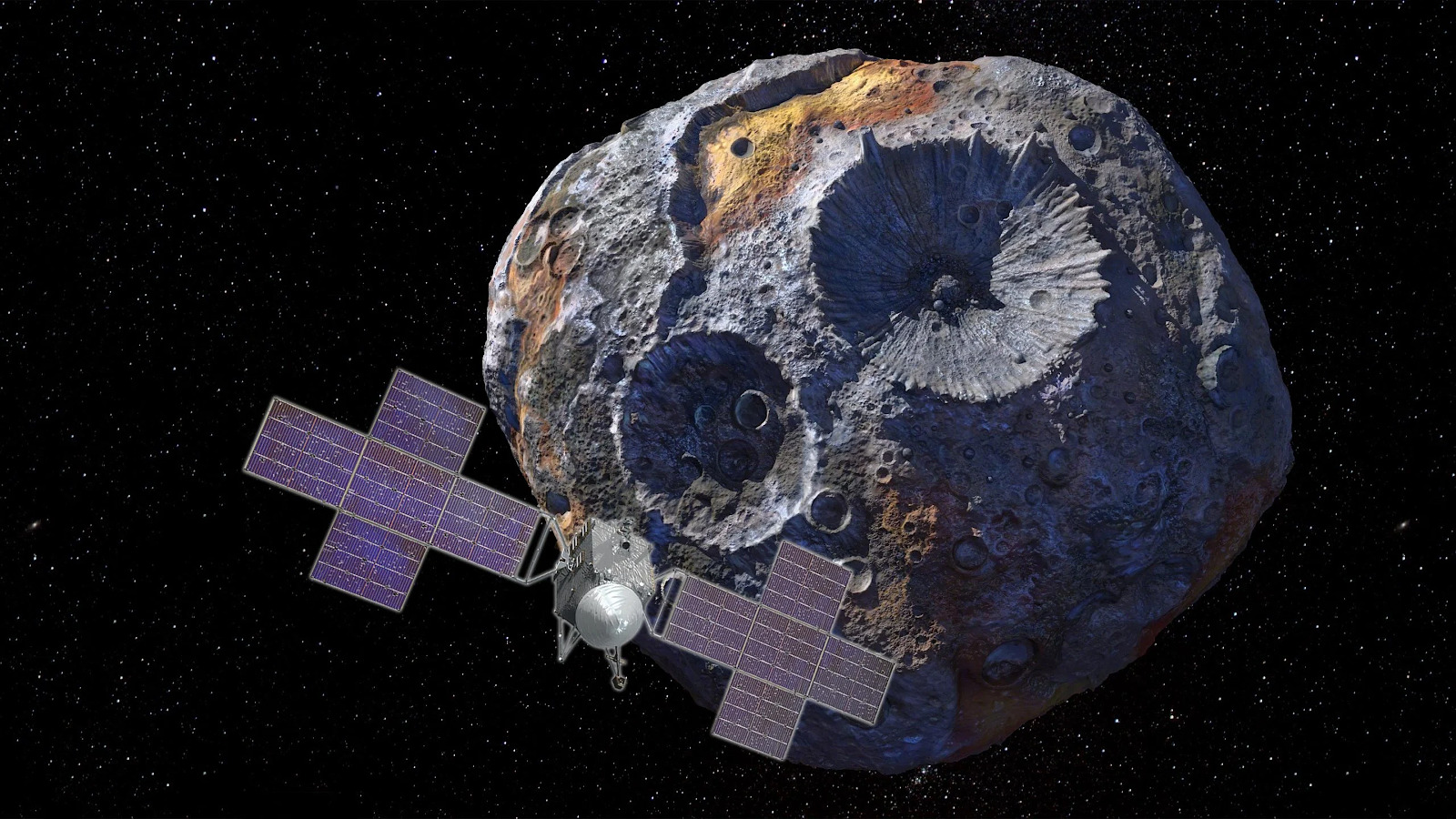
Psyche is on its way to the asteroid of the same name, which it is expected to reach in
August 2029 with the help of its ion engines.
While most asteroids consist of stones and rocks, previous measurements at Psyche indicate a very high metal content. One theory is that it could be
the metal core of a planet, whose outer shells were blown away in a collision with a similarly large celestial body in the early phase of our solar system. Well, that sounds interesting.
I don't expect a shiny metal ball with dents instead of craters. But if it looks different from "normal" asteroids, if there are visible differences for me as a non-expert, I would be thrilled.
One example is
Ceres, which surprised me very much in 2015. Ceres is not one of the usual rocky deserts like
Vesta or even our moon, but a possibly still active minor planet, whose observations by the
Dawn orbiter have raised more questions than they answered.
Since mid-2025, a fuel line has been causing problems and it had to be switched to a redundant line. Otherwise, as far as I know, the probe is doing well and is on its way to its destination.
https://psyche.ssl.berkeley.edu/
https://en.wikipedia.org/wiki/Psyche_(spacecraft)
https://en.wikipedia.org/wiki/16_Psyche
2030 - Europa Clipper
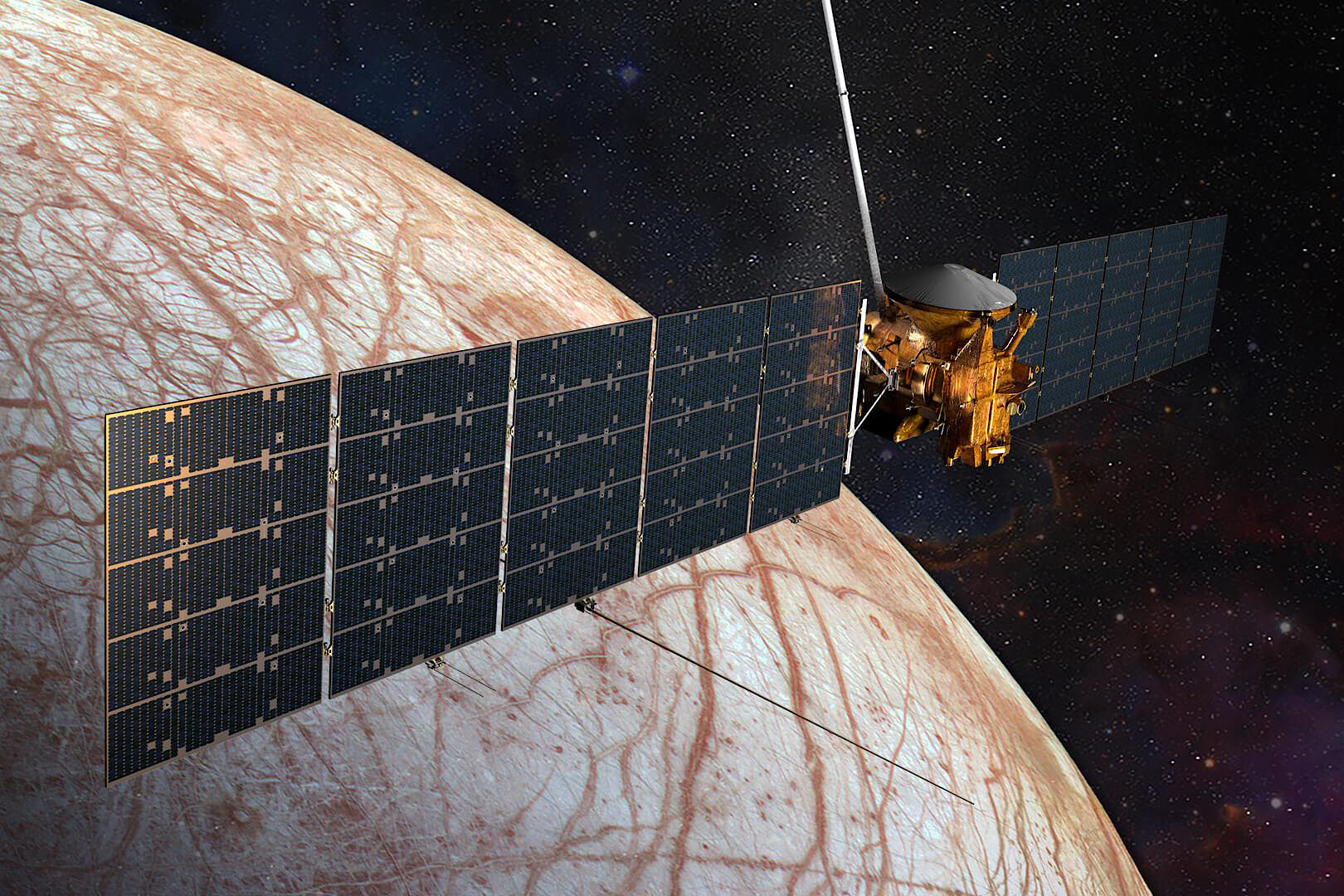
Jupiter's moon Europa makes it into my personal top 5 of the most interesting objects in our solar system. NASA's
Europa-Clipper, launched in 2024, is expected to finally and definitively answer the questions of whether there is an ocean under the ice crust, how deep it is, how thick the ice crust above it, and whether life
could possibly exist in the ocean. The
Juno spacecraft has transmitted a few images to Earth in recent years, but the last high-resolution images were taken by
Galileo in the 1990s.
To avoid the high radiation near Jupiter, the Clipper will not enter an orbit around Europa, but will collect data during
almost 50 flybys. Quickly into the radiation belt, collect scientific data, quickly get out, transmit all data to Earth the week after, and again. Arrival in the Jupiter system is scheduled for
April 2030.
Unfortunately, the Clipper went on the journey a bit battered. A few month before launch, it was discovered that parts of the power supply are not quite as well protected against the immense radioactive radiation as they should be. NASA has decided against replacing the components, because this would have required the probe to be almost completely dismantled and the launch postponed by several years.
So there is a vague possibility that the Clipper will have to struggle with defects after just a few flybys. But just as well, like many other probes, it can last much longer than planned, let's hope for the best. I would be satisfied with five flybys - better this five now than none at all or at the end of the 30s.
https://science.nasa.gov/mission/europa-clipper/mission-timeline/
https://en.wikipedia.org/wiki/Europa_Clipper
https://en.wikipedia.org/wiki/Europa_(moon)
2030 - ELT
For many years from the
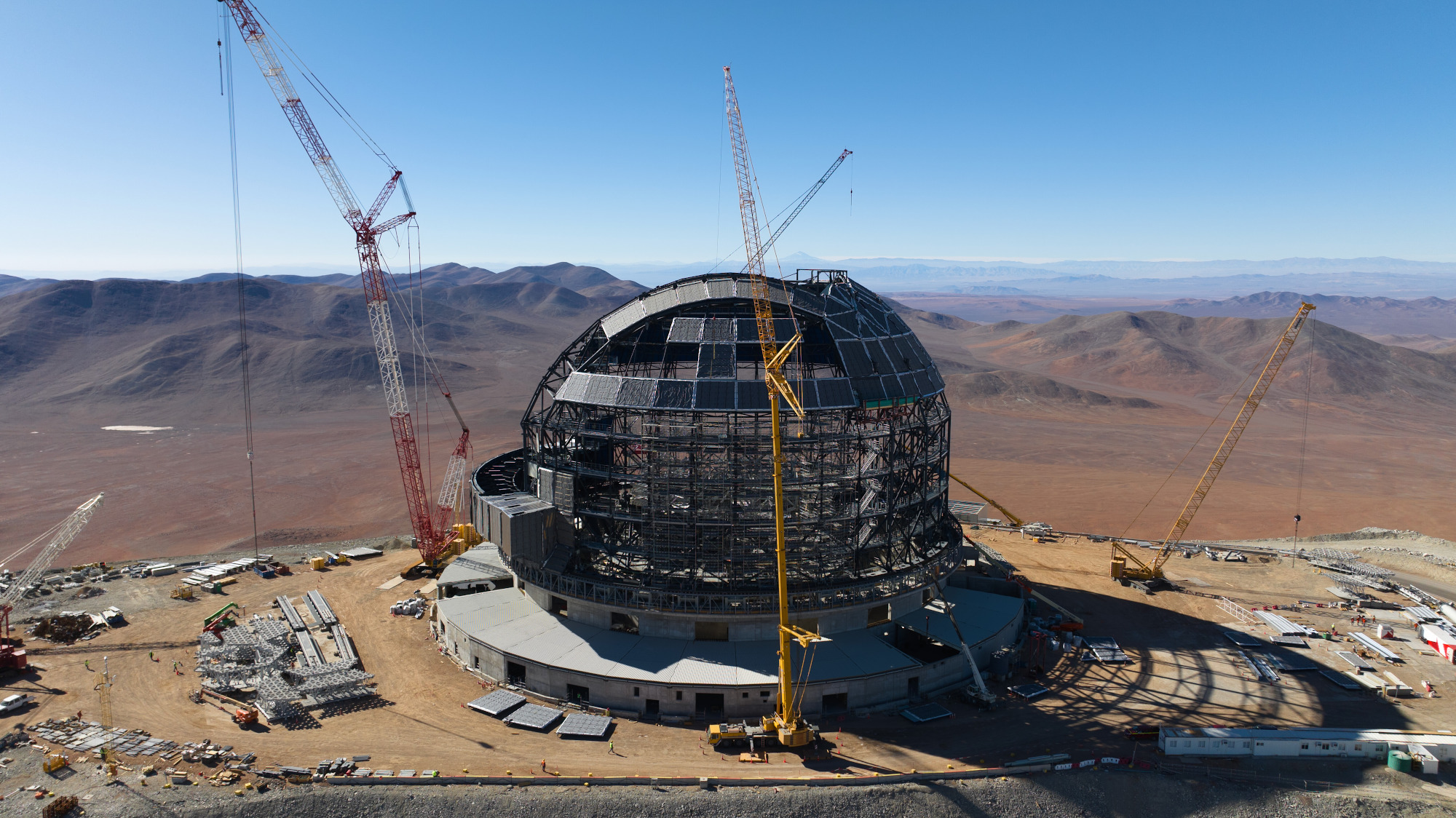
Extremly Large Telescope (ELT) was nothing more to see than a mountain. At some point
the mountain was missing the top, another year later there was
a hole in the ground where the top used to be. Since 2023 has it slowly become clear that the dirty construction site in the Chilean Andes is to become the world's largest observatory.
The
ESO has published a video that shows a
drone flight through the unfinished building and illustrates what an insanely large thing it is supposed to be. One must not forget: Almost all the elements in the video that look so massive are movable, some of them accurate to the millimeter or even micrometer.
Its "first" First Light is scheduled for the end of 2029, the "scientific"
First Light at the end of 2030, and it will go into regular operation at the beginning of 2031. Then we will see what a 39-meter primary mirror consisting of 798 segments can do. With the dimensions, I often wonder whether the planners really know what they have gotten themselves into.
A little negative foresight: This giant will not be able to take real images of exoplanets, even if only with 10x10 pixels. Discovery yes, measurements of the atmosphere yes, but the capture of images with several pixels resolution is unfortunately not possible with such a
tiny telescope.
https://elt.eso.org/about/timeline/
https://en.wikipedia.org/wiki/Extremely_Large_Telescope
2031 - Juice
© ESA
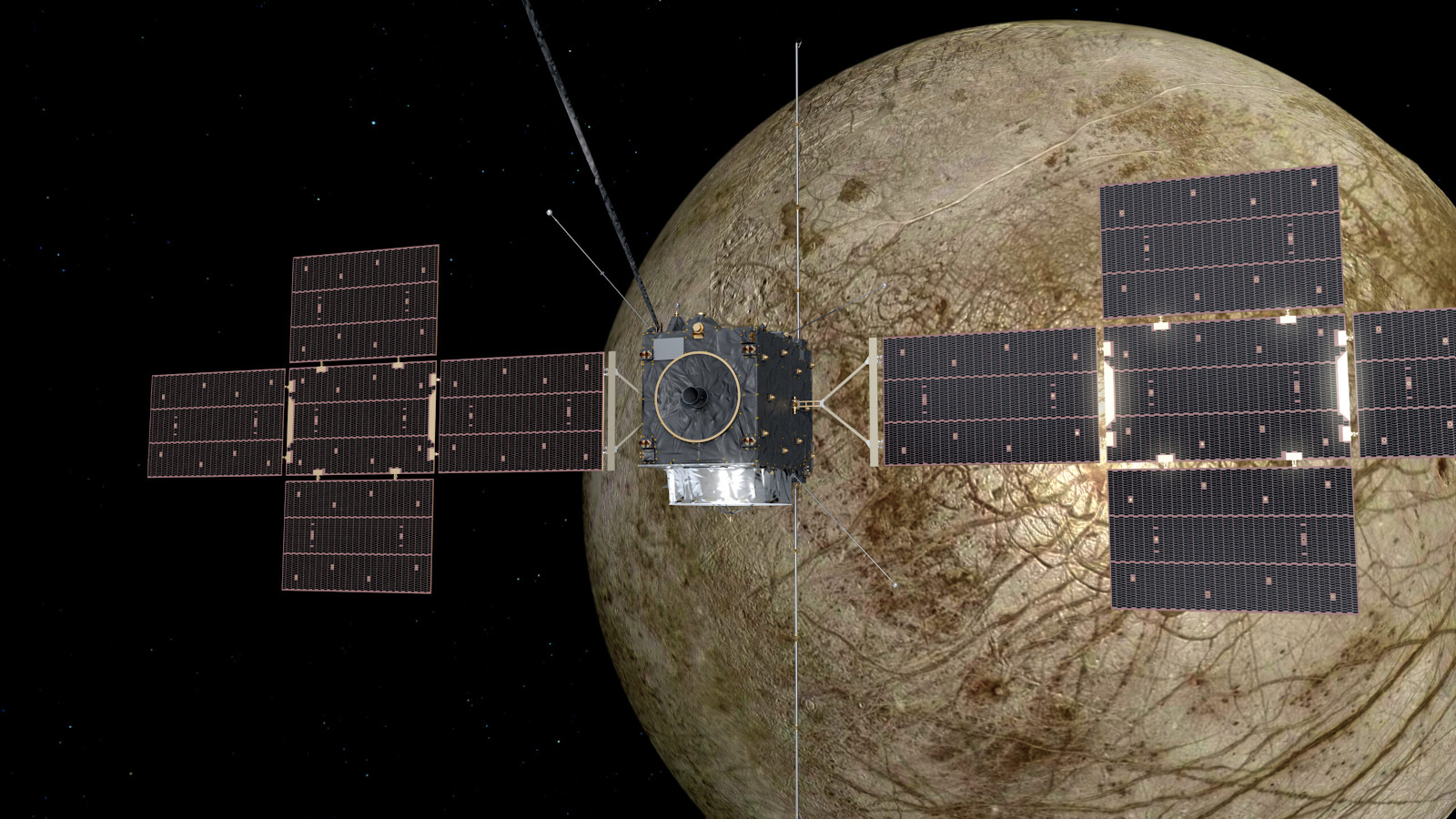
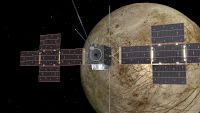
For a long time I had wished for at least one Jupiter orbiter that examines his moons during flybys, but now, in addition to the Clipper, with the european probe
Juice a second one is on the way. After swinging into
Jupiter's orbit in 2031, Juice is expected to slow down into an orbit around
Ganymede, but the latter will not be until 2034.
Like Europa, Ganymede probably has an ocean beneath its icy surface, the existence of which Juice can prove. Before it has the opportunity to do so from 2034, it will fly past different moons dozens of times, examining them and Jupiter itself.
Apart from minor difficulties, one of the stick-shaped radar antennas could not be unfolded at first, the probe is in very good condition and on track. Launched a year earlier than the Clipper, it will travel longer due to several gravity assists and will arrive as the second spacecraft.
Hopefully, ESA will attend a PR course for beginners by then, not be as stingy as usual, and publish more than just one photo a week. Of course, I would like to see the release of the raw images immediately after arrival on Earth, as was the case with Cassini.
https://www.esa.int/Science_Exploration/Space_Science/Juice
https://en.wikipedia.org/wiki/Jupiter_Icy_Moons_Explorer
https://en.wikipedia.org/wiki/Ganymede_(moon)
2032 - Venus
Venus-Orbiter Envision
© ESA
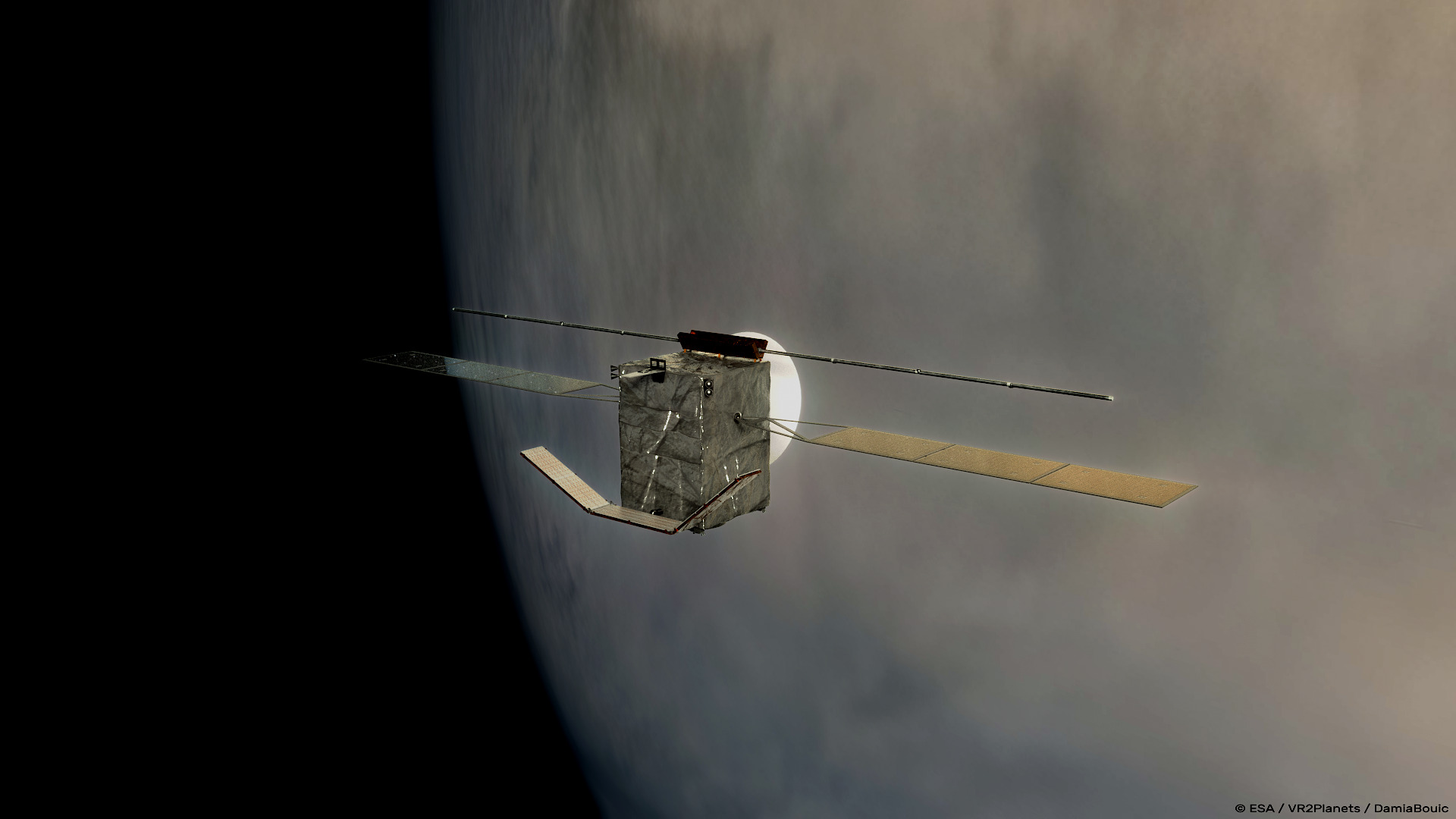
At first one new mission to
Venus was announced, then two, then three, then only one again and at the moment we are back at three (as of March 2026). With the
Venus-Express and
Akatsuki, there have already been orbiters in this millennium that have studied Venus for several years, but the last high-resolution images of the surface were taken by
Magellan in the early 1990s. Nothing
has landed since the mid-80s, there hasn't even been an attempt.
I can't remember that ESA once announced a large orbiter but then did not realize it, so the european spacecraft
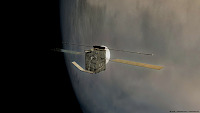
EnVision will almost certainly start its journey. Unfortunately, ESA has found a gravity assist even on the short way to Venus, which is why the orbiter will be on the road for an above-average amount of time.
EnVision is scheduled to launch in May 2032,
brake into orbit in August 2033, and then aerobraking will last until the beginning of 2035. Then the scientific work really will begin, provided that the launch window is adhered to as planned. The wait is worth it, because with a dry weight of 1.3 tons, EnVision is the heaviest of all Venus probes and has a correspondingly large number of high-resolution instruments on board.
Davinci
© NASA/GSFC
NASA project announcements must be taken with a grain of salt thanks to Donald, but
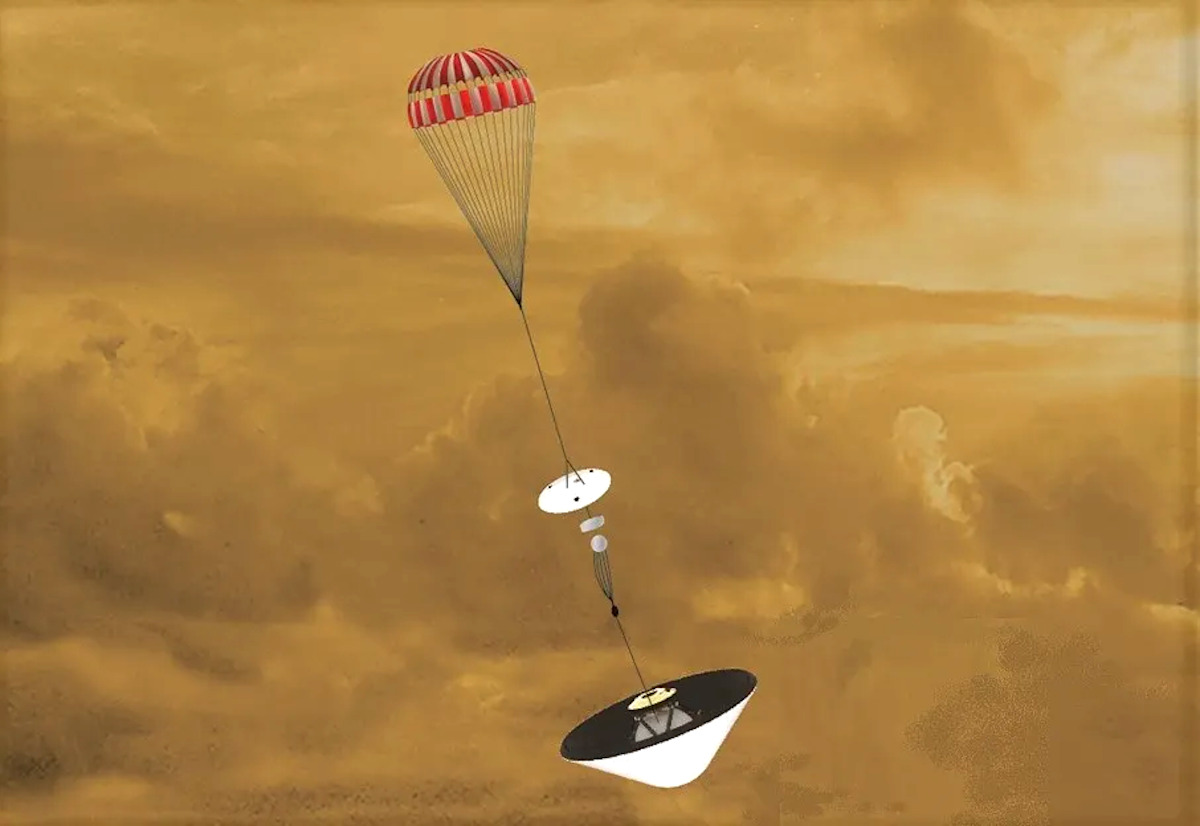
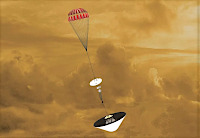
Davinci will probably be carried out. It consists of an
atmospheric probe, which takes measurements
during the descent down to the surface, and a relay orbiter with only limited scientific use. The atmospheric probe is not designed as a lander, it is only intended to record data and images
during the descent, which are transmitted directly to the orbiter. It may survive the landing and be able to send data for another 10-20 minutes afterwards. Launch probably in 2031,
landing in 2032.
The launch of NASA's
Veritas was most often questioned or even canceled. A smaller orbiter than EnVision, but both probes were designed to
complement each other from the beginning. Unfortunately, there was quite a bit of a wrangling around Veritas in terms of financing, which is why it was supposed to start first, then last, then not at all, and now apparently last. I don't believe it until it's on the launch pad, currently planned for 2032,
arrival in 2033.
As a duo or trio, they could collect much better and higher-resolution data about Venus than Venus Express, Akagi and Magellan combined. New radar images from EnVision compared to the old ones from Magellan are likely to reveal surface changes, and there has never been a Venus lander with modern CCD chips on board anyway.
https://www.esa.int/Science_Exploration/Space_Science/Envision
https://science.nasa.gov/mission/veritas/
https://science.nasa.gov/mission/davinci/
https://en.wikipedia.org/wiki/EnVision
https://en.wikipedia.org/wiki/VERITAS_(spacecraft)
https://en.wikipedia.org/wiki/DAVINCI
2034 - Dragonfly
© NASA/Johns Hopkins
APL/Steve Gribben
The finale of The bold Seven is without a doubt heralded by
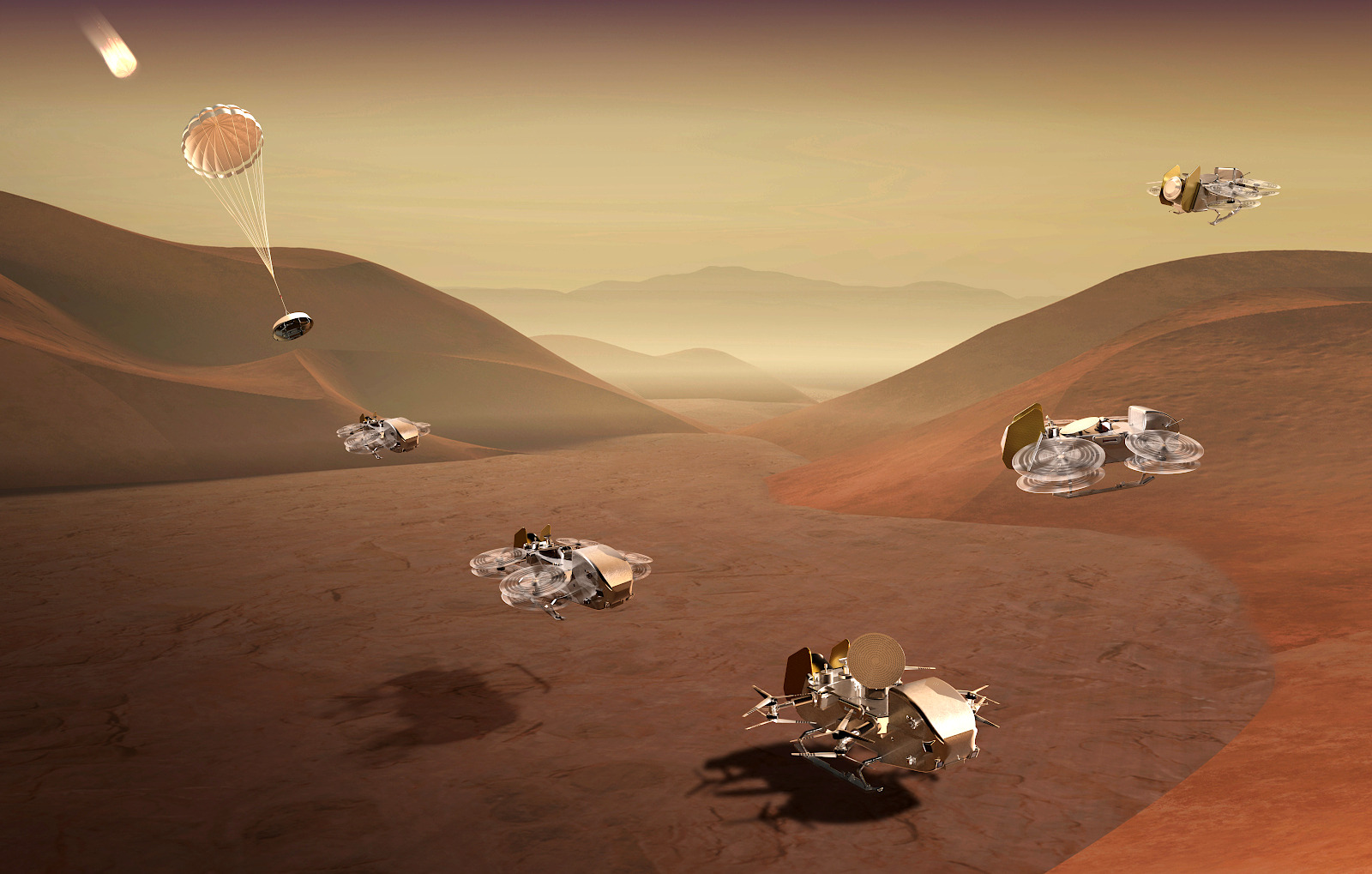
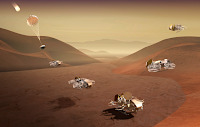
Dragonfly. Protected by a heat shield, the octocopter is to brake into the atmosphere of Saturn's moon
Titan in 2034, be further slowed down with parachutes, uncoupled while still in descent and handed over to its 8 rotors. After landing, data is sent to Earth for over a week, then a new landing site is approached and another radio break is taken.
NASA officially speaks of dozens of landing sites spread over hundreds of kilometers, which are to be approached by Dragonfly within several years. Quite an optimistic imagination, because I'm already happy if everything works out with the first landing. This mission is certainly one of the most daring ever attempted, and with costs of more than $3 billion one of the most expensive.
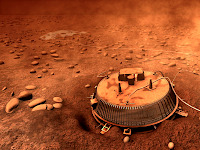
Huygens-Lander
© ESA
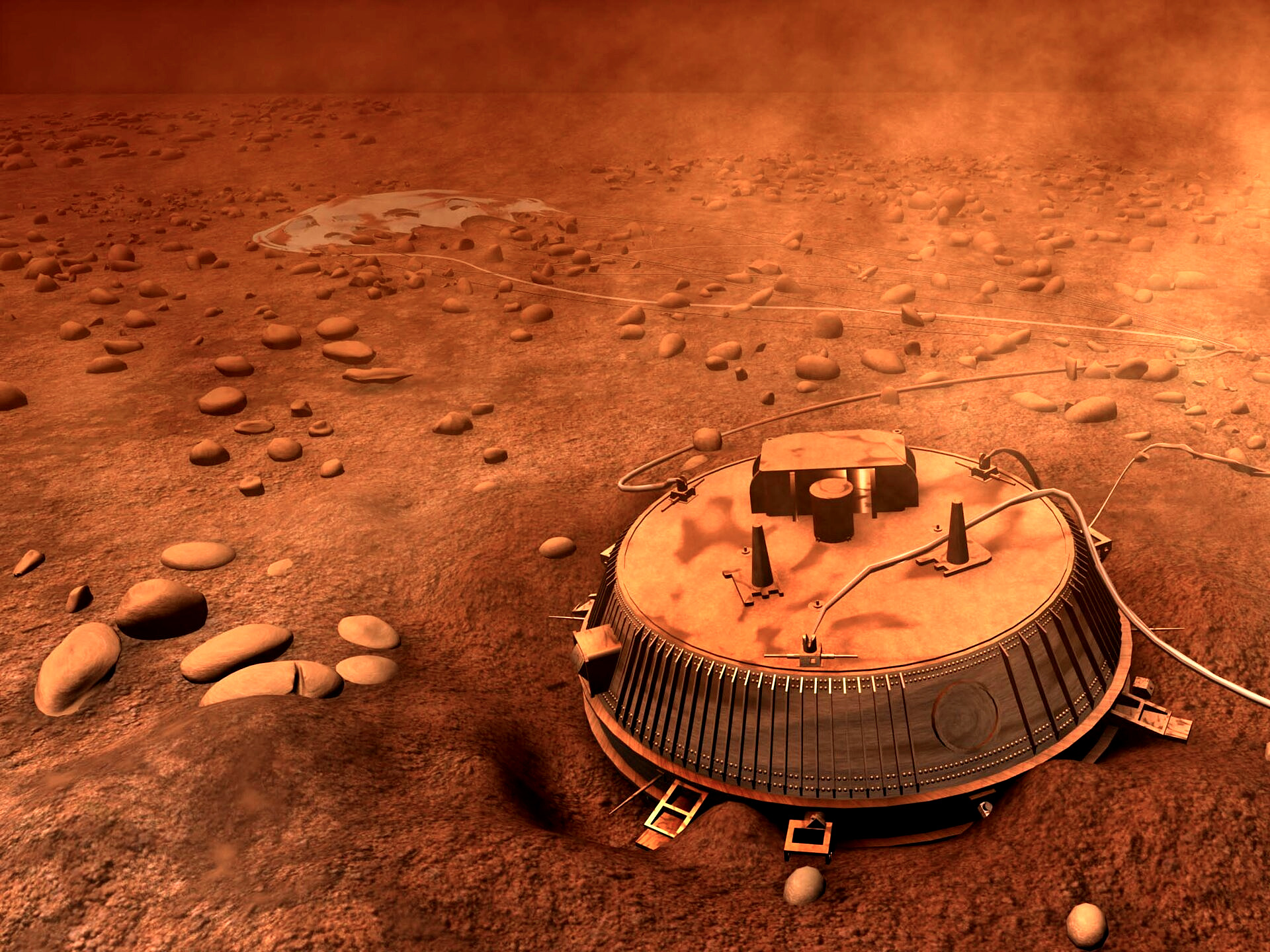
It is scheduled to
start in 2028 and, despite the Trump administration, it currently looks as if the project is going according to plan. The probability is high that Dragonfly will be able to make up for the thumbnail disaster of
Huygens. What was I disappointed when the
first pictures came in after the Huygens landing in 2005 and I thought, why do they only publish tiny pics? Until I read through the specifications of the cameras and found out that
160x256 pixels was the highest resolution and all three could not be swivelled. After all, ESA has now turned
all the images into a video that even looks pretty good.
https://dragonfly.jhuapl.edu/
https://en.wikipedia.org/wiki/Dragonfly_(Titan_space_probe)
https://en.wikipedia.org/wiki/Titan_(moon)
2035 - Data, data, data
From 2035 we will be able to sit back and watch all of them at work. Europa-Clipper, Psyche and Davinci are probably already over, but EnVision, Dragonfly and Juice have only just begun, while the ELT is waiting for the first upgrade of its instruments.
If all goes well, we will be richer by a lot of highly interesting findings by the end of 2035:
- what happens to an asteroid during a close flyby
- whether the metal asteroid Psyche is visibly different
- whether there are oceans on/in Europa and Ganymede
- whether life is conceivable in it
- how thick the ice cover is over it
- how much their surfaces have changed since Galileo
- what it really looks like on Titan
- whether the surface of Venus has shown visible changes since Magellan
- what's going on in the atmospheres of exoplanets
- and much more
Let's not forget, in addition to these monster events, other space probes and telescopes are planned, the results of which will also be highly interesting. I'll take care of that later, there should be some changes in the course of the next few years.
There is hardly any time to dream of the next big projects from 2040.